
One of the biggest challenges that working moms face is finding the right balance between work, family, and our own personal needs.
If our jobs are highly demanding, we might miss out on time at home or feel like we just don’t have the emotional bandwidth to be present with our families at the end of the workday.
Most of us probably want nothing more than to kick our feet up after a hard day at work and decompress.
But for working moms, that’s far from reality. Once we leave our jobs, we go straight into mom-mode.
I wasn’t always great at dealing with work stress. It would weight down on me, affecting my mood, and making me irritable and short with my friends and family.
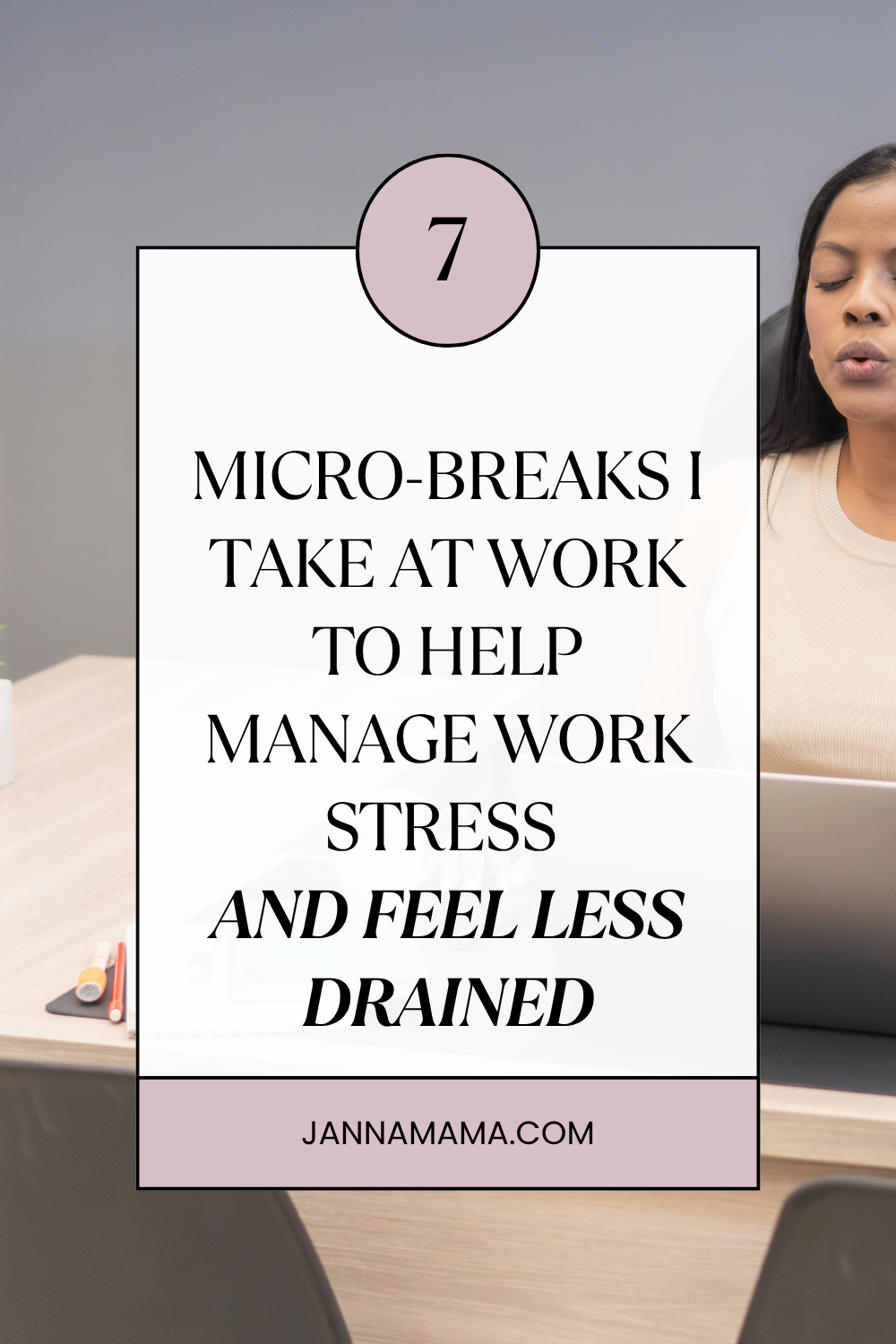
I knew that was no good for anyone, so I started trying to take little micro-breaks for self-care throughout the workday.
They were like mini-wellness moments that recharged my emotional, physical, and mental batteries so my stress didn’t become overwhelming.
Those small breaks have actually had a big impact on my personal life, and they’ve become an essential part of my workday.
In this post, I’ll share how I incorporate small micro-wellness breaks at work, and how that has had a positive impact on my wellbeing and work-life balance.
The benefits of taking micro-breaks at work
The practice of micro-wellness, or taking small 5-10 minute moments for self-care throughout the day, has become popular among our busy, always-on generation.
It’s a simple solution to a very modern problem – we just don’t have the time!
We can apply the same idea to the workplace to temporarily detach from work, refresh, and reset our minds.
It’s like having a little pick me up every couple hours so we can stay energized and happy throughout the day.
For working moms who rarely have large chunks of time for self-care at home, micro-breaks at work can be especially helpful.
For some of us, especially those with young kids, it might even be an opportunity for wellness that we don’t get when we’re at home – it’s pretty tough trying to take a break with a toddler at our heels!
Research supports the idea that taking micro-breaks at work can improve wellbeing and limit work-related fatigue.
That means we have more energy for ourselves and our families when the workday is done.
Here are some of the ways it can be helpful.
Improved focus, concentration, and productivity
Taking micro-breaks throughout the day actually helps to improve our focus and concentration while we are at work, making us more likely to finish our tasks within work hours.
That means we can actually get our work done at work, and not have to spend personal time finishing tasks off the clock.
Reduced mental fatigue and better emotional wellbeing
Mental fatigue occurs when we are focusing on one thing for an extended period of time without taking a break.
Our brains get tired of things that demand constant focused attention, and it can potentially lead to emotional and mental fatigue.
By taking micro-breaks, we give our brains a chance to rest and recuperate. As a result, we have more mental and emotional energy when the workday is done.
Reduced muscle fatigue and better physical wellbeing
Sitting for long periods of time at work may increase the risk of overuse, muscle fatigue, and posture-related injuries like neck or back pain.
Taking micro-breaks can prevent that by encouraging us to move our bodies and change positions, allowing us to avoid the negative effects of prolonged sitting.
Improved resilience and tolerance to work stress
Taking micro-breaks builds our tolerance to handling stress at work, which can make us more emotionally resilient.
That means the bad days at work can stay at work – the negative emotions we experience don’t have to go home with us and affect our interactions with our kids and families.
Improved occupational and overall wellness
When we take regular micro-breaks throughout the day, we improve our overall satisfaction with work – our occupational wellness.
In other words, work feels less draining and we feel generally happier at our jobs.
Better occupational wellness leads to better overall wellbeing, which in turn helps improve our work-life balance and personal life satisfaction.
It’s not always easy, especially in fast-paced or service environments.
I work in healthcare, so I know how it can feel when we can’t take a break for hours on end. Lunch is the only actual scheduled break in my workday, with patients scheduled back to back the rest of the day.
Still, I prioritize taking 1-5 minutes every couple hours outside of lunch to detach and re-energize.
It’s crucial for my mental and physical wellbeing, and to be able to actually do my job well.
Here are 9 ways I take micro-breaks at work.

1. Taking a walk outside
Fresh air and sunlight does wonders for my spirit.
A short walk outdoors puts me in a better mood, reduces the effects of prolonged sitting in an office, and promotes healthy circulation.
Even if it’s cold outside, taking a walk brings me out of my work bubble and into the present moment, giving me some much needed distance and clarity.
2. Doing a breathing exercise
Did you know that doing breathing exercises has positive effects on our mood and stress levels, and also has an actual physiological impact on our bodies?
As little as a few minutes of breathwork helps me manage work-related stress and anxiety, which means I’m much less wound up at work and when I get home.
3. Light stretching
A few minutes of stretching or light exercise is a quick way to help re-energize our body and mind.
Regular stretching also plays a vital role in our physical health by loosening tight muscles, encouraging circulation, and alleviating pain from bad posture or muscle overuse.
Here is an upper body stretch routine I can do at my desk in just a few minutes:
- Neck: look down to the ground and then back up to the ceiling 20 times
- Shoulders: roll the shoulders backwards and forwards in circles 20 times each direction
- Shoulders: tilt the neck sideways moving the ear towards the shoulder on one side for 30 seconds, then the other side for 30 seconds
- Hands and wrists: roll the wrists in circles clockwise and counterclockwise 20 times each direction
4. Practicing mindfulness
Mindfulness is about bringing us into the present moment. It means focusing on what we are doing – in a non-judgmental way – and the sensations and emotions of that moment.
We can mindfully wash our hands, mindfully eat our lunch, or mindfully sit outside.
When I practice mindfulness, I focus only on the present moment – the temperature of the water on my skin, the textures and tastes of my lunch, the sounds of nature, or the warmth of the sun outside.
Mindfulness is a skill that can be developed over time, and practicing it has been shown to reduce stress and improve wellbeing.
5. Listening to a mindfulness meditation
When I was new to the practice mindfulness, listening to a mindfulness meditation online made it easier to start.
Even now, sometimes I have a hard time pulling my thoughts back to the present moment, That’s especially true if I’ve had an emotional morning or am anticipating a busy evening.
It’s easy to find free videos online with a quick search on Google, or use apps like Calm or Headspace.
6. Making a list of things I am grateful for
Gratitude is a powerful emotion that has a positive relationship with our feelings of life satisfaction and wellbeing.
It takes very little time to make a list of 3-5 things I am grateful for, and it helps put things into perspective and instantly lifts my mood.
When we first start making gratitude lists, it’ll probably include the big things – our family, our kids, our life.
But as we continue to reflect on our lives and all the positive things in it, we start to notice and be more appreciative of the little things.
7. Listening to white noise or nature sounds
Certain frequencies of white noise can improve attention and reduce stress, positively affecting our mood and anxiety levels.
Listening to the sounds of nature also has a positive effect on our wellbeing.
Both are easily available online and require basically nothing except a phone or computer and headphones.
Listening to nature sounds – the sound of rain on leaves, birds chirping, or ocean waves crashing on the shore – is one of my favorite micro-breaks to take at work.
8. Coloring
Coloring isn’t just for kids. Adult coloring can reduce our stress and anxiety levels, which positively impacts our overall wellbeing.
When we are coloring, our attention is focused on the activity and in the present moment.
It’s another way for me to promote a mindful, present state of being and detach from work for a short time.
9. Finding a quiet place
Sometimes I don’t necessarily want to do a wellness or mindfulness activity in my micro-break time, but would rather just find a quiet place to escape for a few minutes.
Maybe I’m thinking about my after work to-do list or something I read last night, or maybe I’m just sipping my tea or water in peace.
For working moms who are always on, it can feel good to do nothing for once. That’s perfectly okay.
Micro-breaks at work can be an opportunity for busy working moms to practice self-care, manage work stress, and improve our emotional health.
Micro-breaks promote better work-life balance by improving occupational wellness, making work feel less emotionally draining, and leaving us with more energy for our personal lives and responsibilities.
Taking micro-breaks throughout the workday has helped me to find a better balance between my job and personal life.
- 8 Tips For Managing The Holiday Blues
 The holidays can be a truly joyous time. The activities, the events, the lights, the food, the gatherings… everybody seems to be a little bit more cheerful at this time of year. But… Read more: 8 Tips For Managing The Holiday Blues
 - 13 Everyday Self-Care Items To Upgrade Your Daily Routine
 Self-care – it’s the one thing working moms really could use more of but never seem to have any time for. Juggling work, family responsibilities, and our own personal lives is hard enough.… Read more: 13 Everyday Self-Care Items To Upgrade Your Daily Routine
 - 8 Ways To Practice Gratitude And Feel Less Stressed
 Being a working mom means trying to balance it all – our jobs, our family responsibilities, and our personal lives. As a result, we often experience high levels of emotional stress and even… Read more: 8 Ways To Practice Gratitude And Feel Less Stressed
 - A Holistic Approach To Wellbeing: The 6 Dimensions Of Wellness
 When you think of the word ‘wellness’ or ‘wellbeing,’ what comes to mind? Maybe you think about diet and exercise. Or maybe you imagine going to the spa or meeting up with friends… Read more: A Holistic Approach To Wellbeing: The 6 Dimensions Of Wellness
 - 8 sleep hygiene habits that help me get a better night’s rest
 Many working moms – myself included – with young kids suffer from poor quality sleep and sleep deprivation. There are good reasons why. Between the responsibilities of work and motherhood, it can be… Read more: 8 sleep hygiene habits that help me get a better night’s rest